Old man yells at AI slop in the sky
Google News has always been suspect when it comes to using good sources. Google Discover made us lazy. And AI slop is only making everything worse.


In my previous career, Google was everything. Any quick-hit news post, any thoughtful review, any measured (or not) opinion piece — they all lived and died by Google.
For some it was about the "long-tail" traffic. Unsexy but not unimportant. That's why the internet is littered with what basically amounts to rewritten instruction manuals of the simplest sort, often in question form.
"When is the Super Bowl?" is still my favorite. "What color iPhone should I buy?" is another. "How do I reset this thing I use every day?" Update the year, rinse, and repeat.
Unsexy, but not unimportant. We'd tell ourselves that someone is searching for it, therefore it must be useful. And that's true, I guess, as unsatisfying as the work may be.
Things got even worse with Google Discover. If you want to watch your traffic spike, Google Discover can and will make that happen. Instead of bread and butter search results, it surfaces content in a much bigger way. It's awesome to see, and too tempting not to chase. And chase it the blogs do.
It's why headline writing online has become all but a lost art, replaced by this format: "Thing happened. Here's what we know." Punctuation and all. (The headline purist in me will never not recoil at that.) Those are probably the worst offenders, but in a close second are the personal-take headlines. "I did a thing. What it means." And often that thing is a thing anyone can do — it's just that this thing has a CPM attached to it. (Oh, look, that link goes to some AI-generated LinkedIn slop. Stay with me — that'll be fitting for what's next.)
I've been documenting how I've been using Claude Code for what I think is for good. In addition to that CPM link, here's another example of what we're doing with it is B-A-D. (I will never not hear that in the voice of the orderly Gonzalez in the epic 1983 film The Right Stuff as he chastises Mercury 7 astronaut Alan Shepard for his imitation of the José Jiménez character.)
I still have Google News alerts set up for a number of things. My name. The name of my workplace. And the name of my city, Pensacola. This weekend I got a ping for the latter, for a Delta flight that took off from PNS and had to turn back.
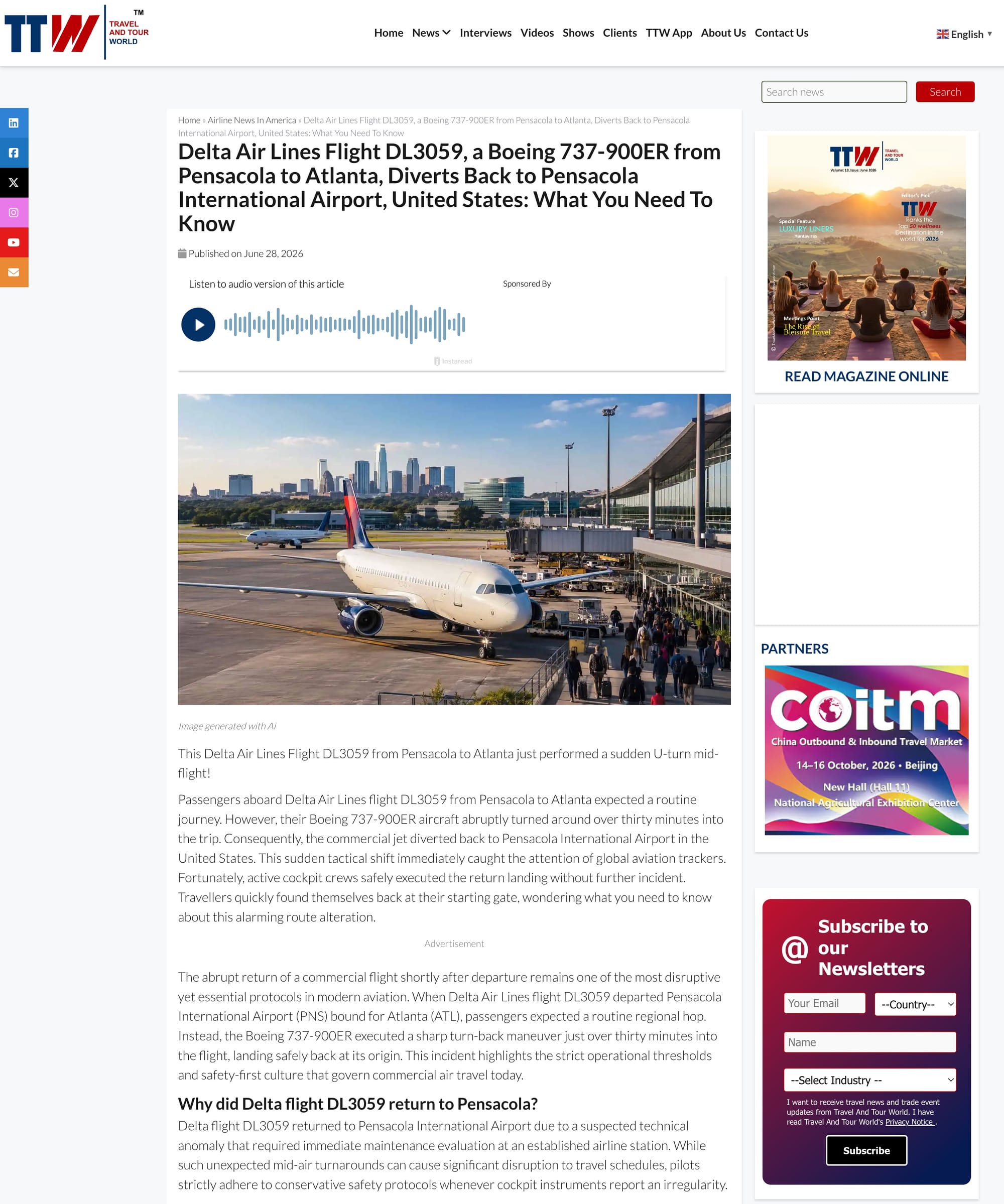
It is AI slop through and through. Let's begin with the headline, complete with that ridiculous kicker:
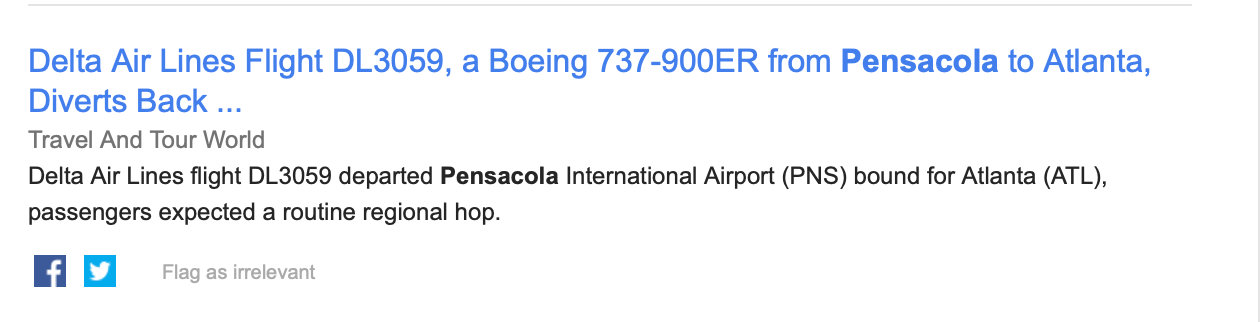
Delta Air Lines Flight DL3059, a Boeing 737-900ER from Pensacola to Atlanta, Diverts Back to Pensacola International Airport, United States: What You Need To Know
That's basically 95 percent of the "story" right there in the headline. Flight number. Aircraft manufacturer and type. Originating and destination cities. And country, because AI is dumb. It takes advantage of the "curiosity gap" phenomenon — another nü-journalism fallacy that is incredibly overused. (And I link where I do there with full irony, just because I can.)
The body of the post gets worse from there. AI-generated audio version. (Great for accessibility, at least.) Ridiculous AI-generated image. AI-generated body copy. This is, to put it mildly, insane:
This Delta Air Lines Flight DL3059 from Pensacola to Atlanta just performed a sudden U-turn mid-flight!
Passengers aboard Delta Air Lines flight DL3059 from Pensacola to Atlanta expected a routine journey. However, their Boeing 737-900ER aircraft abruptly turned around over thirty minutes into the trip. Consequently, the commercial jet diverted back to Pensacola International Airport in the United States. This sudden tactical shift immediately caught the attention of global aviation trackers. Fortunately, active cockpit crews safely executed the return landing without further incident. Travellers quickly found themselves back at their starting gate, wondering what you need to know about this alarming route alteration.
The abrupt return of a commercial flight shortly after departure remains one of the most disruptive yet essential protocols in modern aviation. When Delta Air Lines flight DL3059 departed Pensacola International Airport (PNS) bound for Atlanta (ATL), passengers expected a routine regional hop. Instead, the Boeing 737-900ER executed a sharp turn-back maneuver just over thirty minutes into the flight, landing safely back at its origin. This incident highlights the strict operational thresholds and safety-first culture that govern commercial air travel today.
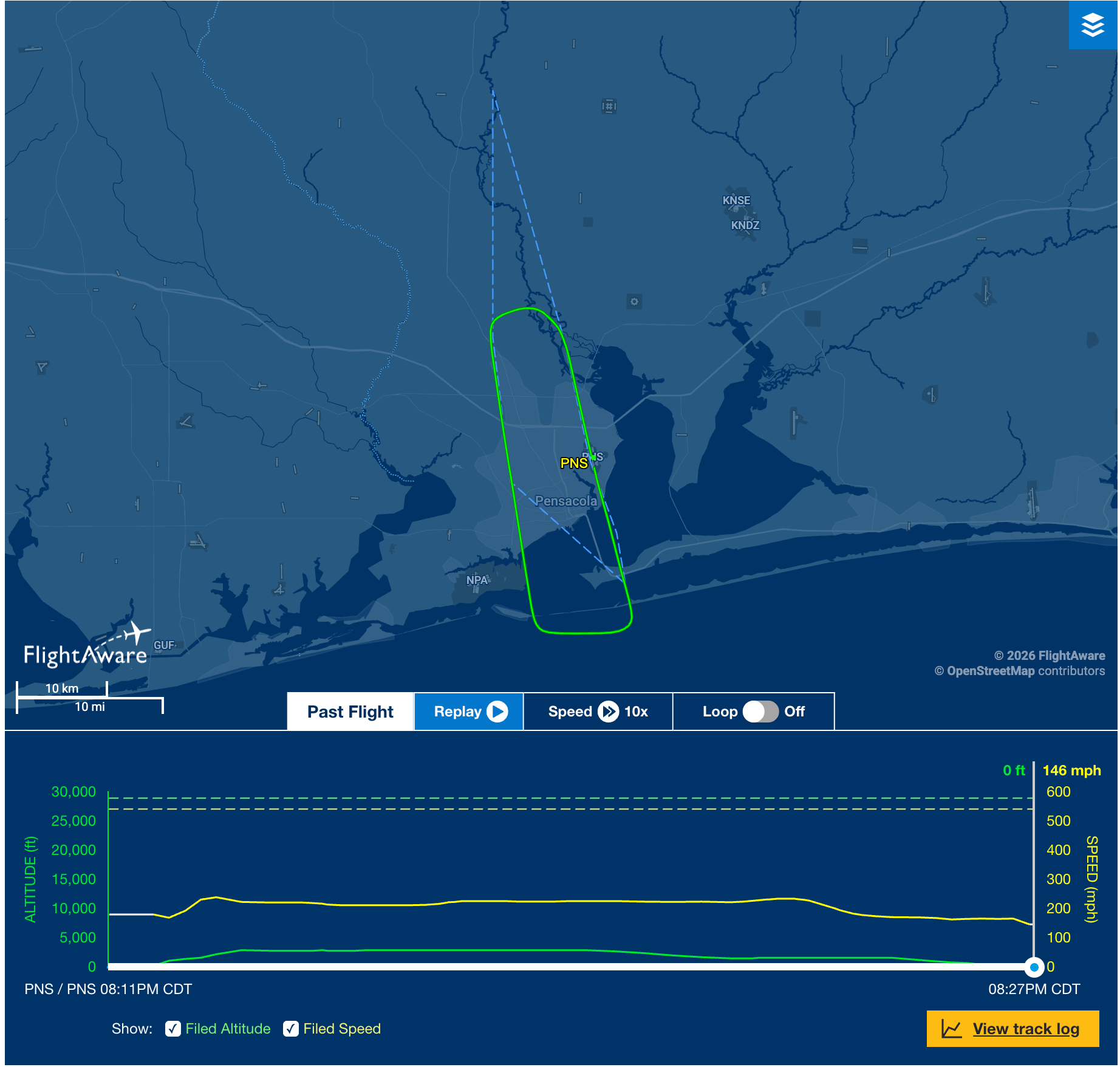
It's not even good AI slop. (Probably a cheap local LLM, which would make sense. Even WeatherBot writes better than that, for mere fractions of a penny per run.) There's nothing "sudden" or "sharp" about passenger planes turning around. It didn't turn around after a half-hour — that would have gotten in most of the way to Atlanta. Instead, it barely got outside the city limits. It took off. The pilots quickly realized something was off. It leveled off at about 2,800 feet, turned around, and landed on the same runway. Emergency? Sure, in that sort of aviation sense. Alarming? Doubtful. They train for this. A lot. Annoying for passengers? Sure. It happens.
The FlightAware data shows it perfectly clearly. Plane takes off. Plane turns. Plane lands.
Worthy of a human-written news post? Nope.
The sort of thing Google News should be surfacing? That's the bigger question.
On one hand, Google did what I want it to do: It fed me something that pinged on the word "Pensacola." But it fed me something so tasteless — not even empty calories — that it might as well not have. And in doing so it encourages that sort of nonsense, just like Google Discover does. The "flywheel" — online journalism loves that term, along with "funnels" — spins ever more.
News is hard enough to do well in the first place. Aviation news, from what I've learned from a few folks actually steeped in it, is even harder. (Actually it's not hard to do well. It's just more work than this AI nonsense. But that's another gripe for another time.)
And as I know all too well, you can't write a story that's the equivalent of "Perfectly routine thing happened and all is well." Nobody will read that.
That should be a sign. It's bad enough that too many human-powered news orgs produce poorly written stories based on this same sort of thing. It's worse that an industry still exists that allows it to be done automatically. That's AI for bad, and "journalism" for worse.